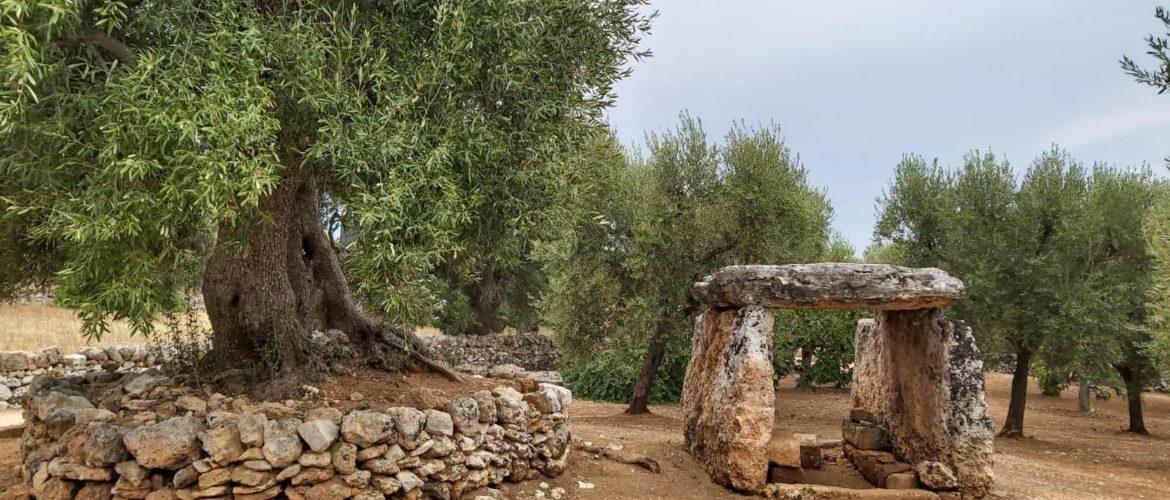
Traveling along the highway from Ostuni to Fasano, turn right after the hamlet of Montalbano and, after about 1.5 km, you’ll find a dolmen on private property that can still be visited today.
But what are its origins, and why is it still one of Fasano’s historical gems today? Let’s find out together!
THE LEGEND
Also known as the “Tavola dei Paladini,” it seems to have originally been used as an altar for sacrifices. In some parts of Europe, local folklore has long held that dolmens were used by the Druids—Celtic priests—for ceremonies and religious practices.
Later, during the early centuries of Christianity, it is believed that dolmens were associated with idolatrous practices, so much so that some Ecclesiastical Councils condemned their use.
According to numerous superstitions and legends, dolmens were manifestations of the existence of giants, woodland spirits, but above all, fairies and witches.
THE HISTORY
This specimen was discovered in the early 20th century by the scholar Michele Gervasio. It dates back to the Early Bronze Age, around 2000–1500 B.C., and its function has been debated and reinterpreted over time.
It is generally believed that the dolmen originally served as a monumental tomb for a family or a single member of the upper class, built near a settlement that has not yet been identified.
The word “dolmen” derives from the Breton words “dol” (boards) and “men” (stone), and thus means “stone boards.”
Furthermore, it appears that dolmens were historically either open burial monuments or covered by mounds of stone and earth.
Apulia is one of the European regions with the highest concentration of dolmens.
WHAT TO VISIT
With a square plan, this dolmen currently consists of two large stone slabs, set vertically into the ground, each approximately 1.70 meters high and 1.50 meters long. There is also a third stone slab placed atop the structure to cover it. The rear wall and the access dromos (corridor) are missing, having been tampered with and removed in the past.
Would you like to visit this piece of local history yourself? Contact our Guest Relations Team; we’d be more than happy to provide you with more information and help you organize your visit!